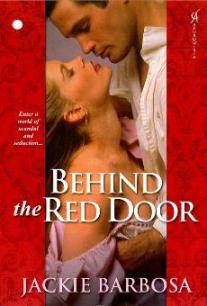
 When Jackie Barbosa, the author of the upcoming erotic historical romance anthology, Behind the Red Door, offered me an early copy of her book, I was so excited! I’d heard great things about her writing, and couldn’t wait to dive in. I read it (devoured it, actually) as quickly as my nutty schedule would allow, and Jackie certainly didn’t disappoint! I thoroughly enjoyed all three stories.
JH:Can you tell me a little about how you sold BEHIND THE RED DOOR to Kensington?
JB: Mostly, it was pure, dumb luck. On something of a lark, I queried John Scognamiglio at Kensington Books with a novella called Wickedly Ever After. I was shocked when I received a request for the full manuscript within less than 24 hours. I dutifully printed and mailed the manuscript, then started checking the mailbox for the rejection letter. A couple of weeks after I mailed the manuscript, I received an email from John asking if I had outlines for the other two connected novellas mentioned in my cover letter. I said, yes, of course. (I didn’t say they were only in my head.)
I wrote out the outlines and sent them by email. A month passed. One afternoon at 4pm, the phone rang. My son answered it. “Mom, it’s for you,” he hollered. Thinking it was someone from my office, I came downstairs to answer in my bathrobe (I tend to shower late in the afternoon–ah, the life of a work-at-home mom!). When John identified himself, I nearly fainted. I don’t think I heard a word after that, but I knew I’d just been offered a contract for publication.
JH: How and why did you start writing romance?
JB: The why part of that question is a lot easier to answer than the how. I write romance because I love to read romance. Although there’s more to it than that, if I’m honest, because there are many other genres I also enjoy reading (I’m a sucker for a good murder mystery, for example, and love historical fiction). But I love reading and writing romance because it allows me to relive those giddy days when I, myself, was falling in love, and because, though I’m remarkably cynical and unromantic in many ways (I’d take a practical car over a diamond ring as a present any day), I do believe in happy endings and happily ever after.
The how is harder because, once I discovered romance in my reading material, I was already an obsessive writer (which is not to say a good one, lol). I can’t remember a time when I didn’t write and/or tell myself stories. Once I discovered romance as a reader, though, I knew it was what I wanted to write.
JH: Why have you chosen the historical period of the Regency as a setting for your stories? Do all the stories you write take place in the Regency?
JB: I’ve always like reading Regencies, but when I started writing, I actually concentrated on the early Victorian period more than the Regency because I’m interested in the way the social strata of English society was changing at that time and how that can drive the conflict between two characters from different classes. I’m not comfortable, however, in the later parts of the Victorian period (neither hoops skirts nor bustles sit well with me from a fashion perspective, lol), so I’ve always tended toward the earlier part of the 19th century.
Behind the Red Door wound up being set in the Regency primarily because the stories just seemed to FIT in that era. Particularly, Scandalously Ever After, the middle novella, virtually required a Regency setting because the hero is tortured by his memories of war, and although the English were certainly involved in wars throughout the 19th century, the Peninsular Wars were the most defining.
JH: Writing novellas can be a challenge for authors who are used to writing longer (like me!). What’s your secret?
JB: Um, short attention span? Seriously, one of the best things about writing short is that, when you hit 25k, you’re almost done. There’s just not time to become bored with the story or the characters or worry too much that everything you’ve written is a waste of byte space. I have a lot of unfinished manuscripts to my name, and they mostly remain unfinished because I lost interest in them and got a better idea at right around the 25-30k mark. But it’s a lot easier to avoid that if, at 25-30k, you’re darn near done.
That said, the first book I ever finished writing was a single title that clocked in at a massive 136k in the first draft. I didn’t have the first idea about writing short, and worse, I realized that in writing a long story with a complex subplot, I was losing sight of the romance, which after all, was why I was writing the book in the first place.
So, when Ann Aguirre challenged her blog readers to write a short (<15k) for an Ellora's Cave call for submissions, I took up the gauntlet and came up with an idea for a Regency-set short that I called Carnally Ever After. Writing that short was difficult, but I learned a lot from it, including exactly how to keep the story focused on the developing romantic relationship.
For me, writing novellas was a great exercise. I think it taught me how to write a tighter, stronger romance. Now, as I go back to tackling full-length novels with subplots, I find I do a better job of not wandering too far away from that romance, even when I’m exploring the sub-plot elements.
JH: Do you consider Behind the Red Door erotica or erotic romance? What is the difference between erotica and erotic romance?
JB: Behind the Red Door is definitely erotic romance because each of the stories focuses on the development of a single romantic relationship and ends with a happily ever after for the protagonists. For me, the defining characteristic of a romance is the focus on the courtship/falling in love and the HEA ending.
Erotica, by contrast, doesn’t need to have an HEA ending (or even a “happy-for-now” ending) and doesn’t focus on the protagonists developing a romantic relationship, but rather on the protagonists’ exploration of sexuality and sexual relationships. To me, that’s a key difference. One isn’t better than the other, by any means, but they are different.
I kind of think of the difference between erotic romance and erotica as being roughly akin to the difference between traditional romance and mainstream women’s fiction with romantic elements. It’s all about the focus of the story. If the focus is the romantic relationship (whether between two character or more than two characters), it’s a romance, even if that relationship is developed and explored primarily through sex. If the focus is on sexual exploration and discovery, then it’s erotica, even if there are some romantic elements.
Or at least, that’s my opinion ;).
JH: Of your three heroines, Miss Eleanor Palmer, Calliope, and Lady Jane, which one do you see yourself most likely to become close friends with?
JB: I suppose Eleanor and I have the most in common since we both spent a fair proportion of our time reading and translating Greek and Latin poetry–and at roughly the same age! But both Callie and Jane hold special places in my heart, so really, it’s a tough choice.
JH: If you were trapped on a desert island with your heroes, The Marquess of Grenville, Captain Jack Prescott, and Gerard Nash, and they all were vying for your “attentions,” which one do you think you’d succumb to first?
JB: Again, tough choice! But if I had to guess, I’d Jack would get to me first. He’s just so darned tortured and in need of rescue and sympathy. But I’m pretty sure I’d succumb to the other two in very short order!
JH: What are you working on now?
JB: I’m hoping to go out on submission soon with a proposal for a series of three single title historicals set in early Victorian England. The first, titled Unashamed, features a decidedly non-traditional heroine and a former French spy as the hero. More than that, I’m not willing to say. I have this curious fear of “jinxing” it by saying too much.
Thanks so much for visiting with me today, Jackie! You’ve got me thinking about super sexy erotic historical romances–after reading this fantastic book, I’m hankering for more!
If you comment with a book suggestion for me, I’ll enter you in a drawing to win a signed copy of Jackie’s Behind the Red Door! Winners will be announced at midnight (Pacific time) on Friday, May 22.


 Comments Off on Definitely Stranger than Fiction